Google Business Profile optimization used to be a task you finished once. Fill the fields, pick a category, gather some reviews, and the local pack did the rest. That version of the job is over. In 2026 a layer of AI answers sits above the map, and it does not link to your profile so much as read it, summarise it, and decide on your behalf whether you belong in a response that names three businesses instead of ten.
The awkward part is that nothing about the profile got harder. The fields are the same fields. What changed is the penalty. An incomplete profile used to rank badly; now it gets skipped, because a model asked for a plumber who opens at 7am and takes card payments can only name businesses whose data actually says so.
What actually changed in local search
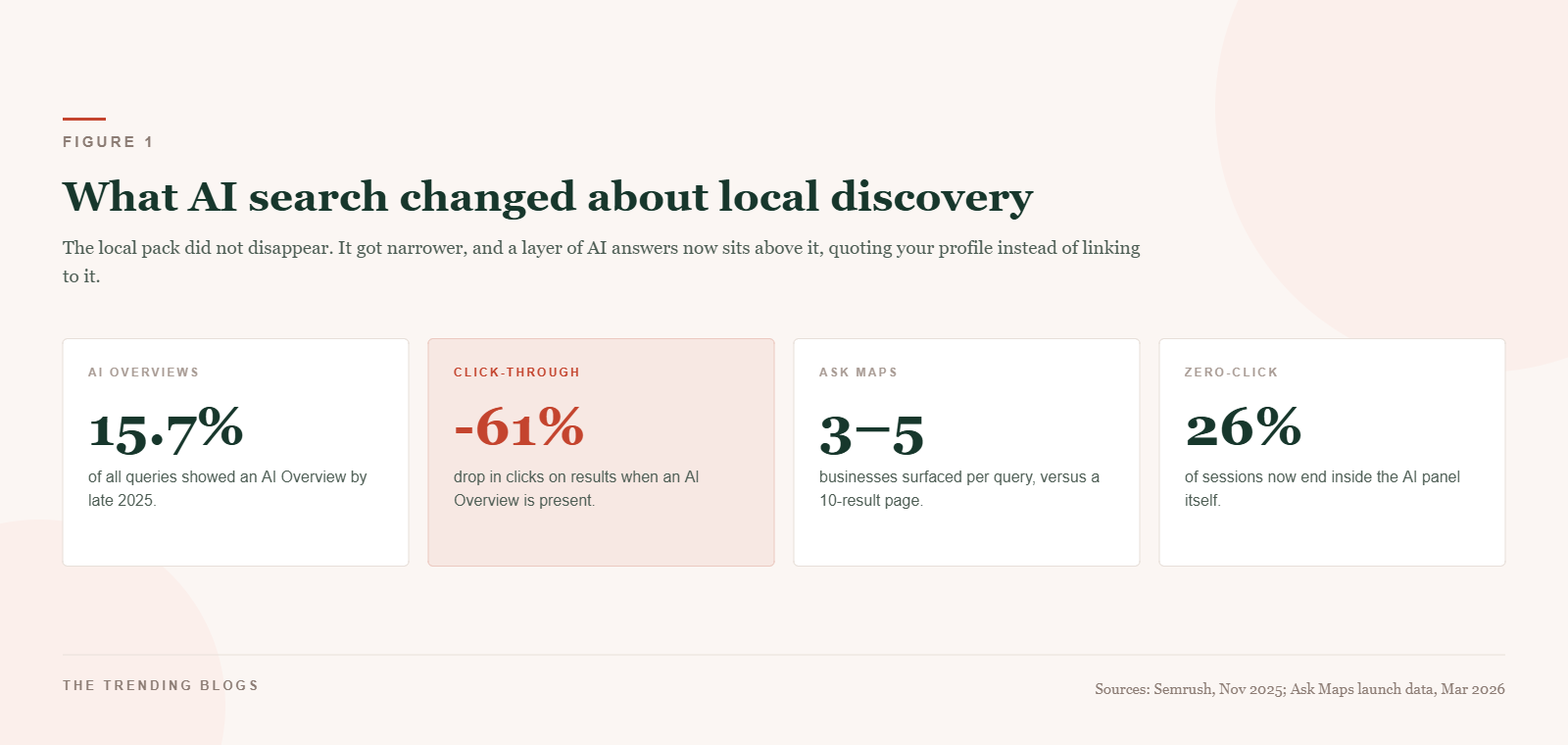
Three numbers frame the whole shift. AI Overviews appeared on roughly 15.7% of queries by late 2025. When one is present, click-through on the results below it falls by around 61%. And Ask Maps, which launched in March 2026, surfaces somewhere between three and five businesses per query rather than a scrollable page of ten.
Read together, they describe a funnel that got narrower at exactly the point where local intent is highest. Roughly a quarter of sessions now end inside the AI panel itself, which means the answer was the destination. You were either named in it or you were invisible, and there was no second page to be on.
This is the same mechanic that governs every other AI surface, and the underlying playbook is not new: here is how AI search optimization gets your business cited by ChatGPT and AI Overviews, and here is the wider picture of how AI is changing digital marketing in 2026. Local search is the version of that story where the data lives in a Google form rather than on your website.
The five profile fields that decide whether you get quoted
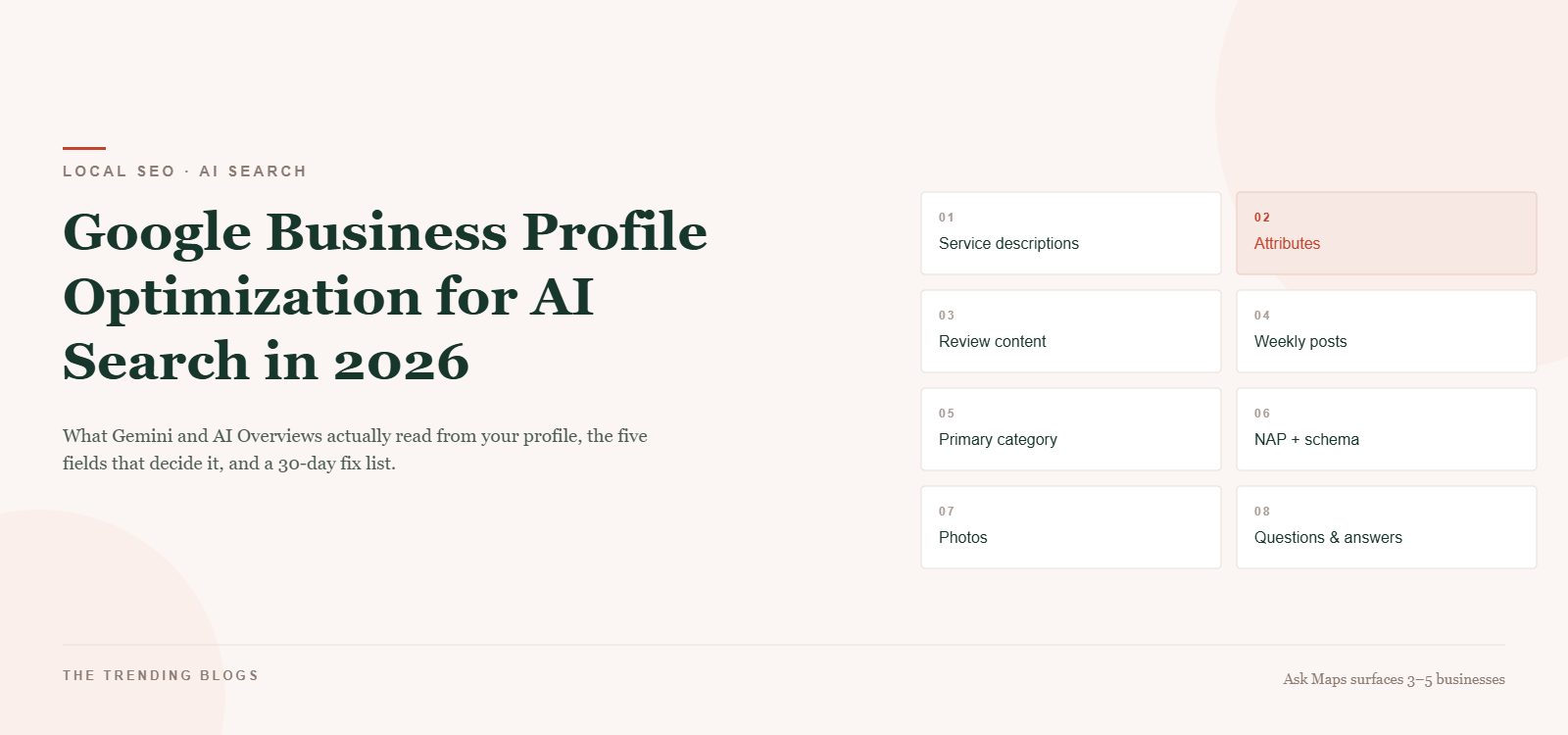
Not all fields carry the same weight now. These five are the ones an AI answer draws from directly, in rough order of how much difference they make.
- Primary category. Pick it by what you actually sell most of, not by what sounds most impressive. Secondary categories widen your reach; the primary one decides which questions you are eligible for at all.
- Attributes. Parking, wheelchair access, payment methods, appointment requirements, languages spoken. These behave like filters: a query with a constraint in it quietly removes every business that left the matching attribute blank.
- Service descriptions. The single most under-used field on the profile. Written in plain, specific sentences, these get quoted verbatim in answers. Written as keyword soup, they get ignored.
- Business description. Name the specialisations and the service area explicitly. A model needs a sentence it can repeat, not a paragraph of adjectives.
- Review content. Star count has plateaued as a differentiator. What matters is whether reviews describe situations: the emergency call at 11pm, the quote that held, the two-day turnaround. Detailed reviews give an AI answer something quotable; a wall of five-star praise gives it nothing.
A useful test: read your profile back as if you were the answer. If nothing in it could be lifted as a sentence that answers a real question, there is nothing there to cite.
A 30-day fix list, in order
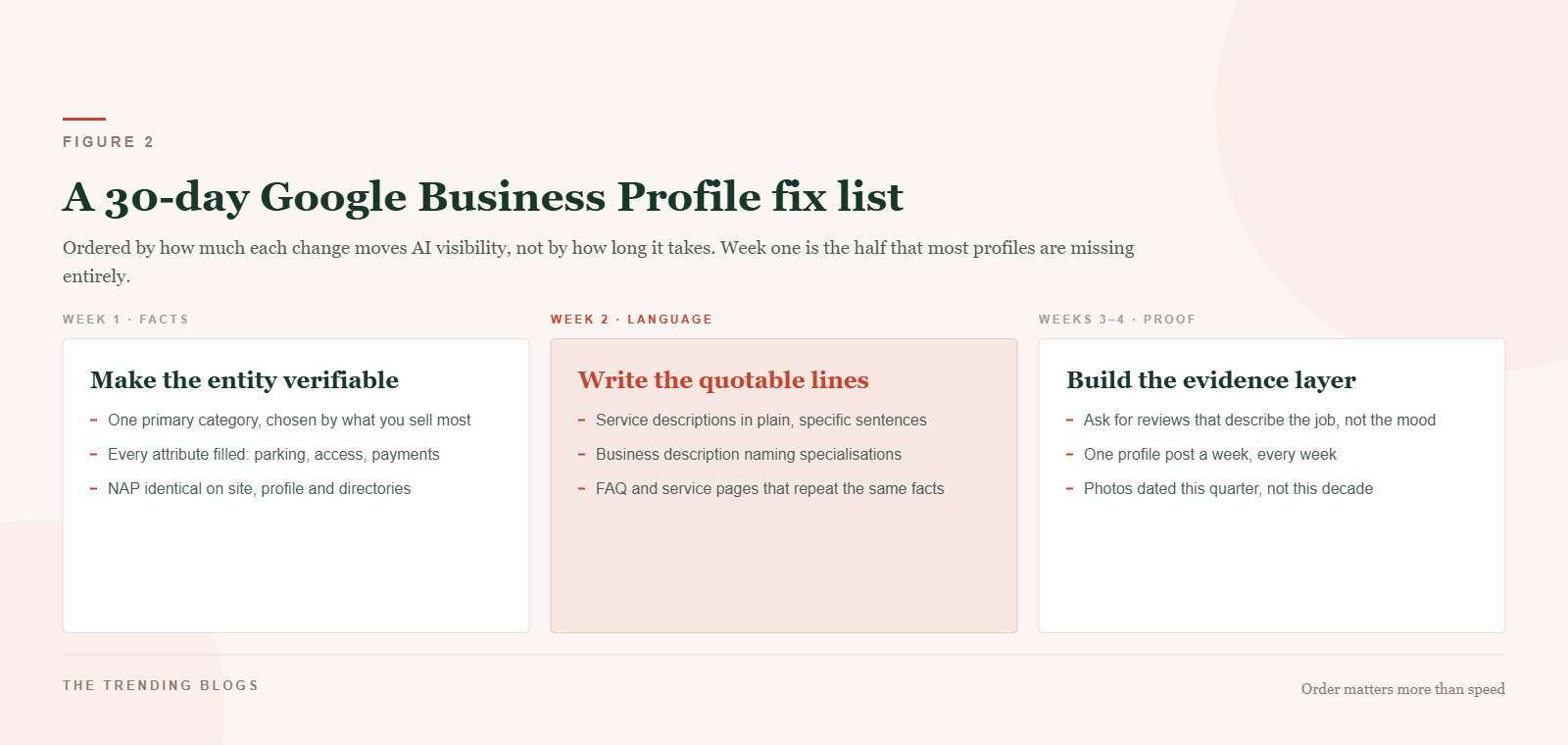
The order matters more than the pace. Facts first, because language written on top of wrong facts just propagates the error. Then the language. Then the proof that any of it is true.
Week 1 — make the entity verifiable
One primary category chosen honestly. Every attribute filled, including the ones that feel trivial. Hours that are actually correct, holidays included. And name, address and phone number identical across your website, your profile and every directory that lists you — identical, not similar. Inconsistent details are the most common reason a model treats a business as two half-confirmed entities instead of one solid one.
Week 2 — write the quotable lines
Rewrite every service description as something a person would say out loud. Rewrite the business description to name what you specialise in and where you work. Then mirror those exact facts on your website in a service page and an FAQ, so the same claim appears in two independent places. Consistency across sources is what turns a claim into a fact.
Weeks 3 and 4 — build the evidence layer
Ask for reviews in a way that produces description rather than praise: ask what the job was, not how it went. Publish one profile post a week, every week, because cadence signals an operating business. Replace photos older than a year. None of this is glamorous, and all of it is the part competitors abandon by month two.
Your website is still the spine
Profiles get quoted, but websites get verified against. Schema markup, a consistent NAP block, service pages that match your service list, and an FAQ that answers the questions people actually type all give a model corroboration for what the profile claims. Treat the site as the source of truth and the profile as its summary.
Two unglamorous conditions sit underneath that. The site has to load — we documented how we cut load time from 6.8s to 1.2s — and it has to be up and recoverable, which is a different discipline covered in the WordPress security and backup checklist. An intermittently broken site undermines every citation the profile earns.
Any LocalBusiness schema on your site should match the profile exactly. Blog schema markup in 2026 explains what Google still reads and what it ignores.
Rewriting the fields, concretely
Most profiles fail on phrasing rather than effort. The pattern is always the same: a field written to impress a human skimming a page, when it needed to be written as a fact a machine could repeat.
| Field | What is usually there | What gets quoted instead |
|---|---|---|
| Service description | Premium, affordable AC repair services with expert technicians | Split AC and window AC repair, same-day visits until 9pm, gas refill and PCB replacement done in-house |
| Business description | We are a leading provider committed to customer satisfaction | Family-run electrical contractor serving Powai and Chandivali since 2011, licensed for commercial fit-outs up to 50kW |
| Attributes | Half filled, defaults left as-is | Card and UPI accepted, wheelchair accessible entrance, appointment optional, street parking available |
| Review prompt | Please leave us a 5-star review | Could you mention what we fixed and how long it took? |
The right-hand column is longer, more specific and less flattering. It is also the only column that can be lifted into an answer without being rewritten, which is the entire game.
What has stopped working
- Review volume for its own sake. Two hundred generic five-star reviews now lose to thirty descriptive ones.
- Keyword stuffing the business name. Still against the rules, still reported by competitors, and increasingly worthless as a ranking lever.
- Bulk citation blasting. Fifty low-quality directory listings with slightly different phone formats create the exact inconsistency you were trying to fix.
- Thin service-area pages. Twenty near-identical pages naming twenty suburbs read as one page to a model that summarises meaning rather than counting keywords.
- Set-and-forget profiles. Freshness is now a signal in its own right. A profile untouched for eight months reads as a business that may not exist.
How to tell whether it is working
Profile impressions alone will look worse over time, and that is expected — fewer people click when an answer already appeared. Watch the actions instead: calls, direction requests, message threads, and branded search volume. Those are the metrics that survive a zero-click surface.
Then do the crude test monthly. Ask the assistants directly — name the service and the city, and see who gets named back. It takes ten minutes and tells you more than a rank tracker. If you want to automate the weekly post, the review requests and the monthly check, there are practical patterns in our list of AI automation ideas for small businesses, and the tooling worth paying for is in our shortlist of AI tools for small business.
Google Business Profile optimization: the short version
Google Business Profile optimization in 2026 is data hygiene with a writing problem attached. Make the facts verifiable, write the sentences you want repeated, and produce enough recent evidence that the business is clearly operating. Three slots is a brutal constraint, and it rewards the profile that is easiest to quote rather than the one that shouts loudest.
One strategic consequence worth naming: when organic local visibility is capped by a three-result answer, paid media stops being optional as a pressure valve. If that is the direction you are heading, start with how to split a small business budget between Meta Ads and Google Ads rather than guessing.
