Two years ago, AI in digital marketing mostly meant a faster way to write captions. In 2026 it has moved somewhere far more uncomfortable for marketers: it now sits between your business and your customer. It answers the question before they reach your site. It decides which of your ads to show. In a growing number of cases, it is doing the shopping.
That shift changes what good marketing actually looks like. Here is what has genuinely changed, and what to do about it.
1. Search Answers the Question Instead of Sending the Click
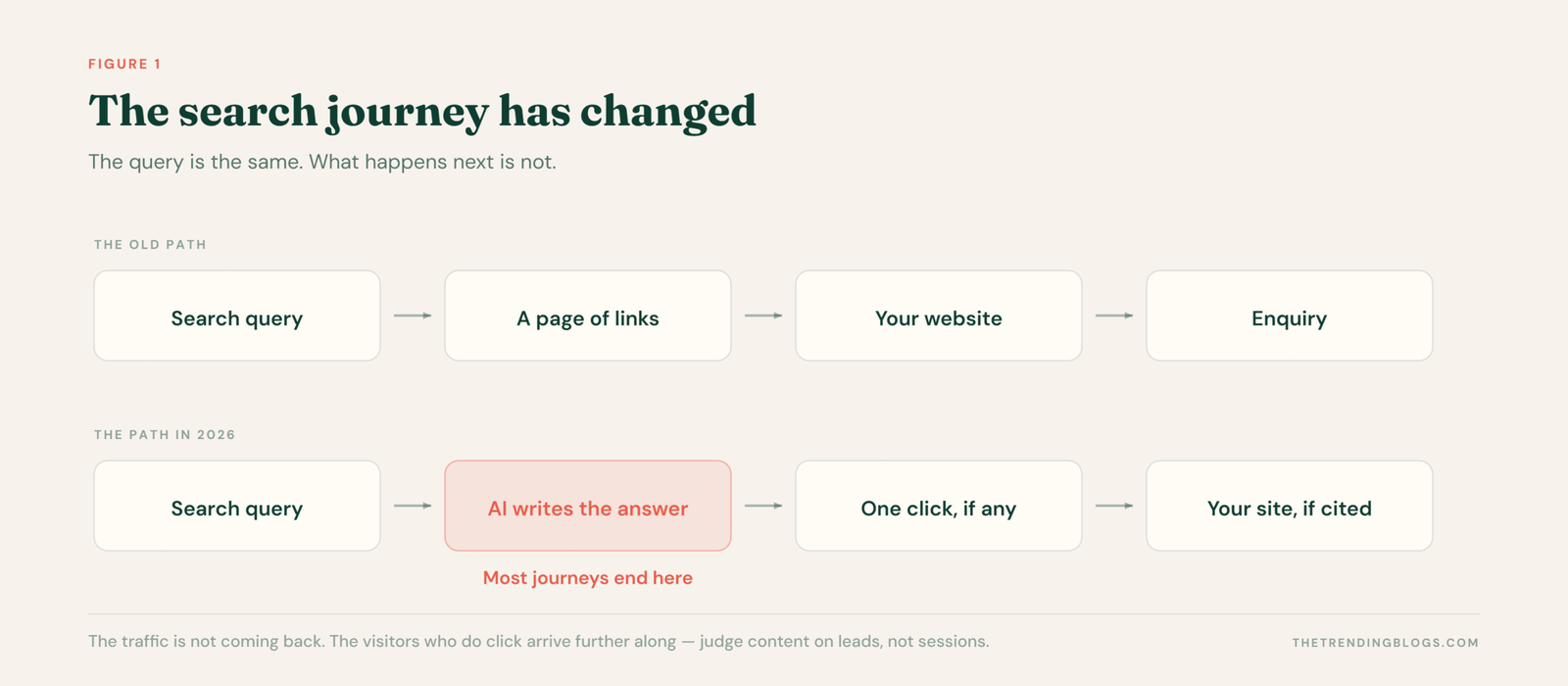
The biggest structural change is the rise of AI generated answers at the top of search, alongside people searching directly inside assistants like ChatGPT and Perplexity. The result is the same either way: the user gets their answer without visiting anyone.
Analyses through 2026 have consistently found meaningful click-through declines on queries where an AI answer appears, with the sharpest drops on purely informational searches. If your blog traffic has fallen while your rankings held steady, this is almost certainly why.
The uncomfortable part is that the traffic is not coming back. The useful part is that the visitors who do click are further along and convert better. Judge your content on leads and revenue, not sessions.
2. SEO Has Grown a Second Discipline: Getting Cited
The industry has settled on names for it, mostly AEO (answer engine optimisation) or GEO (generative engine optimisation). Strip away the acronyms and the goal is simple: be the source the AI quotes.
In practice that means writing differently:
- Answer the question in the first two sentences, then explain. Burying the answer under 400 words of preamble gets you skipped.
- Use clear question style headings so a model can extract a clean, self contained answer.
- Publish specifics that only you have — your pricing, your process, your data, your results. Generic advice is already in the model. Your numbers are not.
- Be consistent everywhere. Your site, your listings, your profiles and third party mentions should agree on who you are and what you do.
- Get mentioned on sources these systems trust, including review sites, trade publications and industry directories.
Note that the last point is closer to PR than to traditional SEO. That is not an accident. Visibility in AI answers is driven heavily by what other credible sources say about you.
3. Ad Platforms Now Make the Decisions
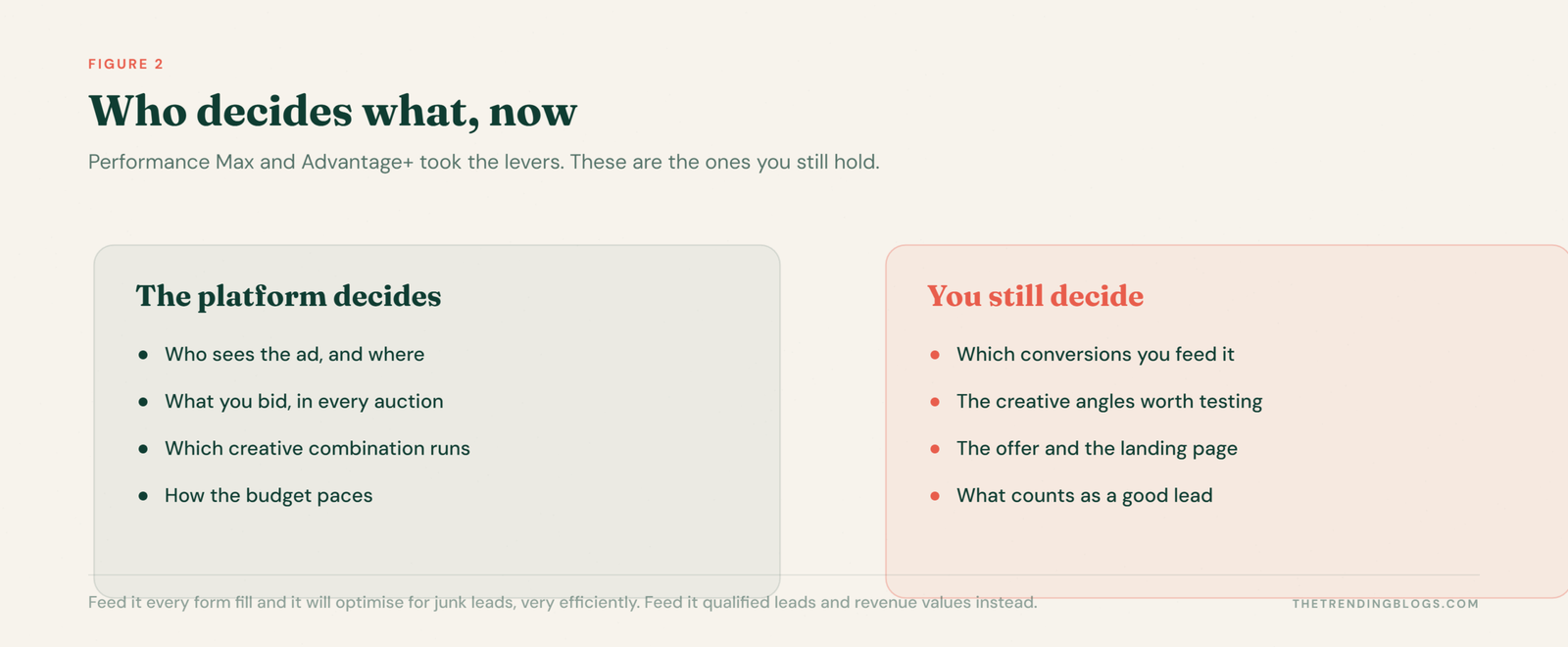
Google Performance Max and Meta Advantage+ have moved most campaign management out of the advertiser’s hands. Targeting, placement, bidding and creative combinations are decided by the platform. The manual levers marketers spent a decade mastering have largely been removed.
What still belongs to you is more important than what was taken away:
- Conversion quality. If you feed the algorithm every form fill, it will optimise for junk leads with great efficiency. Feed it qualified leads and revenue values instead.
- Creative variety. The system needs genuinely different angles to test, not five colour variants of one idea.
- Offer and landing page. No amount of machine learning fixes a weak offer.
- Exclusions and brand safety. Automation will happily spend your budget on your own brand searches or the wrong audience if you let it.
The job has shifted from operating the campaign to feeding it well and auditing what it does.
4. Creative Production Stopped Being the Bottleneck
Generative image and video tools have collapsed the cost of producing variations. A concept that took a week and a shoot now takes an afternoon. Teams that used to run four ads a quarter can run forty, and most of that production now happens inside the same AI tools a small business already pays for.
The catch is that everyone can do this, so volume alone is worth nothing. The scarce thing is now the idea: a sharp insight about your customer, a claim nobody else can make, a proof point that is actually yours. AI is very good at producing thirty versions of a concept and very bad at knowing which concept deserves them.
On the organic side the same logic applies to social: it is now realistic for a small team to automate Instagram marketing end to end. There is also a real audience shift. As feeds fill with obviously synthetic content, visibly human material — real customers, real premises, real staff, unpolished footage — is standing out more, not less.
5. Personalisation Became Practical for Small Teams
Behavioural segmentation, dynamic email content and send time optimisation used to require an enterprise budget. Those features are now standard in mid tier email and CRM platforms, which means a five person business can run the kind of lifecycle programme that used to need a dedicated team.
Start with the basics that reliably pay: abandoned cart or abandoned enquiry sequences, post purchase follow ups, and win back campaigns for lapsed customers. Those three cover most of the available revenue before anything more sophisticated is worth attempting. They are also among the easiest automations to set up in an afternoon.
6. Measurement Got Harder, Not Easier
Privacy changes, cookie loss and AI intermediaries have broken the neat click path that attribution models were built on. Someone can now discover you inside an AI assistant, look you up directly a week later, and arrive as untracked direct traffic.
Practical responses that work for small and mid sized businesses:
- Ask every new customer how they heard about you, and record the answer somewhere you can count it.
- Watch the trend in total leads against total spend rather than defending individual channel attribution.
- Run occasional holdout tests. Pausing a channel for two weeks tells you more than any dashboard.
- Track branded search volume as a proxy for the awareness you cannot otherwise attribute.
7. The Machine Customer Is Arriving
Gartner has predicted that a substantial share of consumers in advanced economies will soon use AI assistants capable of making purchases on their behalf. Early versions of this are already live in shopping assistants and agentic browsing tools.
If an agent is comparing options for your customer, it reads structured product data, clear specifications, availability, return policies and reviews. It does not respond to your brand video. Clean, machine readable product information is quietly becoming a competitive advantage.
What to Actually Do This Quarter
- Ask an AI assistant what it says about your business and your category. That is your new homepage for a lot of buyers.
- Rewrite your top five pages to answer their core question in the opening lines.
- Audit what conversions you are sending to your ad platforms. Fix the quality of that signal before touching anything else.
- Add a “how did you hear about us” field and start collecting it.
- Publish one piece of content this quarter containing original data or results only your business has.
AI in Digital Marketing: Common Questions
Is SEO dead because of AI search?
No, but its goal has shifted. Ranking still matters; being the source an AI answer cites now matters just as much, and that depends on clear answers, original data and credible third party mentions.
What do AEO and GEO actually mean?
Answer engine optimisation and generative engine optimisation are both names for optimising to be quoted inside AI generated answers rather than to win a click from a list of links. In practice the work overlaps heavily with good SEO and PR.
How do I get my business mentioned in AI answers?
Answer the question in your opening lines, use question style headings, publish specifics only you have such as your pricing and results, keep your details consistent everywhere, and earn mentions on sources these systems already trust.
Why has my organic traffic dropped while rankings stayed the same?
Almost always because an AI generated answer now sits above the results and resolves the query without a click. The remaining visitors tend to convert better, so judge content on leads and revenue rather than sessions.
Should small businesses still run Google and Meta ads if the platform automates everything?
Yes. What you control moved rather than disappeared: the quality of the conversion data you feed the platform, your creative angles, your offer and landing page, and your exclusions.
Final Thoughts
AI has automated the execution layer of marketing almost completely. What it has not automated is judgement: knowing which customer to chase, which claim is true, which offer is worth making, and which numbers deserve to be trusted.
The marketers doing well in 2026 are not the ones using the most tools. They are the ones who understand their customer well enough to tell the machines what matters.
Related Reading
- 10 AI Tools Every Small Business Should Use in 2026
- AI Automation Ideas That Can Save Small Businesses Hours Every Week
- How to Use AI to Write Ad Copy That Doesn’t Sound Like AI
Read next: the search half of this shift deserves its own playbook — AI search optimization: how to get your business cited by ChatGPT and AI Overviews. For the operations half, see what AI agents for small business can and cannot be trusted with.
