AI agents for small business finally stopped being a demo in 2026. The models got good enough to hold a multi-step task together, and the tooling got cheap enough that a five-person company can run one. What has not changed is the failure mode: teams buy an agent for the wrong job, it does something confidently wrong in front of a customer, and the whole idea gets shelved for a year.
The short version: agents earn their keep on tasks that are repetitive, well-bounded and reversible. They lose money on anything requiring judgement, negotiation, or a decision you would not let a new hire make unsupervised in week one. Pick by that rule and the technology works.
Agent or automation? The distinction that decides your budget
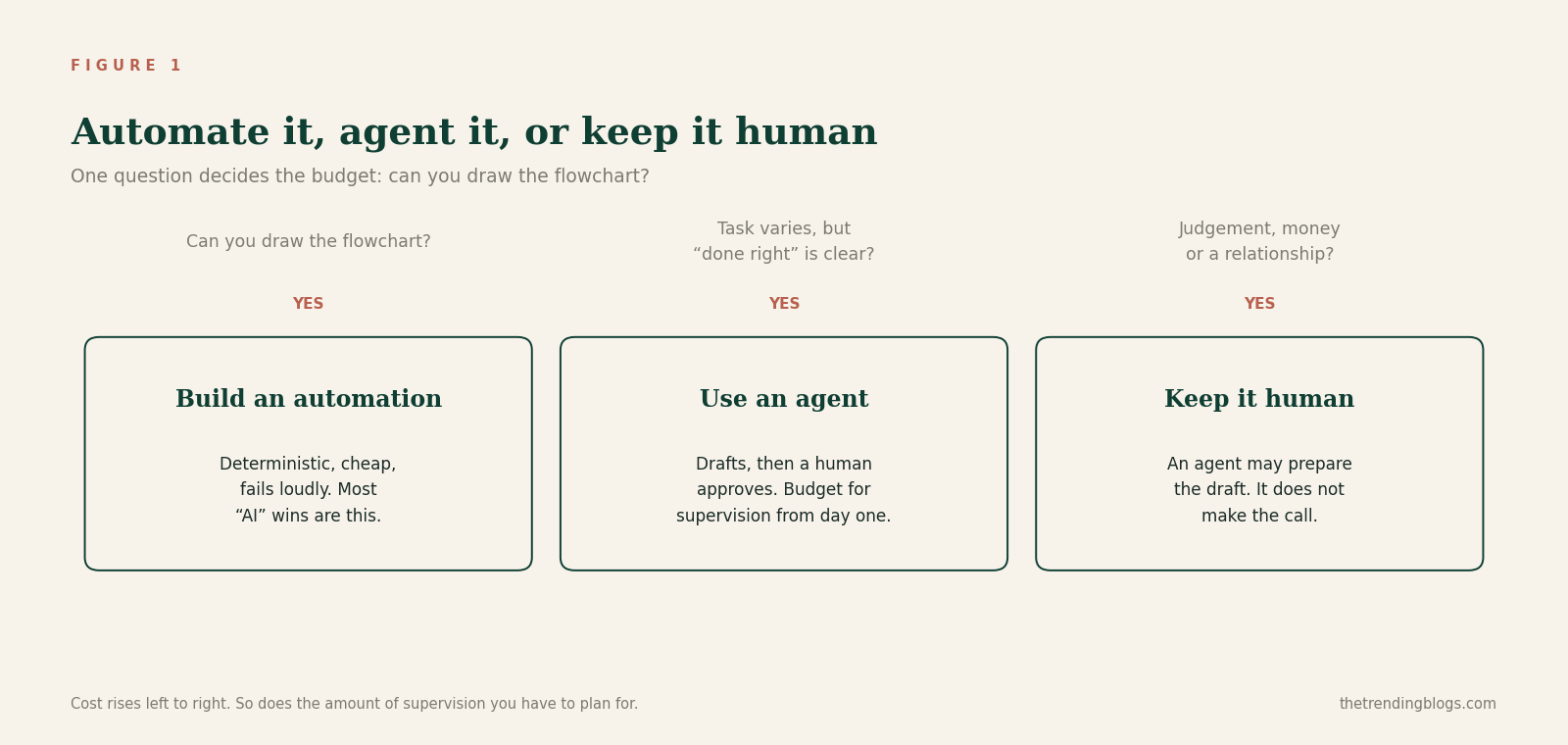
An automation follows a fixed path. When a form is submitted, add a row, send an email, tag the contact. It is deterministic, cheap, and it either works or visibly breaks.
An agent is given a goal and chooses its own steps. Read this inbox, work out which messages are quotes, pull the relevant prices, draft a reply, escalate anything unusual. It is probabilistic, considerably more expensive per task, and it fails quietly rather than loudly.
That difference has a direct commercial consequence. If you can draw the flowchart, you do not need an agent. Build the automation, pay a fraction of the cost, and sleep better. Most of the wins in our list of AI automation ideas for small businesses are exactly this: flowchartable, and therefore cheap.
You reach for an agent when the flowchart has too many branches to draw — when the work is genuinely varied but the standard for “done right” is still clear.
The four jobs AI agents genuinely do well
1. First-line customer support on a documented product
An agent with access to your help docs, order system and returns policy will resolve the majority of routine tickets — where is my order, how do I change plan, does this fit that. The condition is the documentation. An agent on top of a thin knowledge base invents answers. An agent on top of good docs is the single highest-return deployment available to a small business.
Set the escalation rule before you launch, not after: anything about money, cancellation, or an angry customer goes to a human immediately.
2. Lead qualification and follow-up
Speed of first response is still the largest controllable variable in conversion, and it is the thing small teams are worst at. An agent that replies in under two minutes, asks three qualifying questions, and books a slot on the right calendar is doing work that would otherwise not happen at all at 9pm on a Saturday.
Keep it honest about what it is. Customers dislike being tricked far more than they dislike talking to software.
3. Research and drafting, stopping short of publish
Competitor monitoring, pulling a weekly summary from five data sources, turning a call transcript into a proposal draft, writing the first version of a social calendar. The pattern that works is agent drafts, human approves. The pattern that fails is agent publishes. The same boundary applies to social scheduling — worth reading alongside how small businesses can automate Instagram marketing, where the approval step is what keeps the account sounding human.
4. Back-office reconciliation
Matching invoices to payments, chasing overdue accounts, categorising expenses, flagging the transactions that do not fit. Dull, rule-adjacent, high volume, and fully reversible when wrong. This is the least glamorous use and often the one that pays for the whole experiment.
Where agents still fail in 2026
No honest guide to AI agents for small business skips the limits. These are the five that quietly kill pilots:
- Long chains without checkpoints. Reliability compounds downward. A step that is 95% right is 60% right by the tenth step. Break long workflows into short runs with a verification point between them.
- Anything with a legal or financial consequence. Contract terms, refunds above a threshold, pricing exceptions, regulatory answers. Draft, do not decide.
- Judgement calls dressed as routine work. “Reply to this complaint” looks like support and is actually relationship management.
- Undocumented processes. If the knowledge lives only in one person’s head, an agent will fill the gap with plausible fiction. Write the process down first; you will find that half the value was in writing it down.
- Systems without a clean API. An agent driving a brittle interface breaks on the day that interface changes, usually silently.
Most of these jobs run on an automation platform underneath. Zapier vs Make vs n8n compares what each one costs at small-business volume.
What it actually costs
The cost of AI agents for small business falls into three buckets. Be honest about the third — it is the one that sinks projects.
| Bucket | What it covers | Notes |
|---|---|---|
| Platform | Agent builder or per-seat SaaS subscription | Predictable; the number on the pricing page |
| Usage | Model tokens per task run | Scales with volume and with how much context you feed it — measure per task, not per month |
| Supervision | Human time reviewing, correcting and maintaining | Highest in month one, never reaches zero. Plan for it or the ROI is fiction |
The right comparison is not “agent versus employee”. It is “agent plus supervision versus the current cost of the task, including the cost of it being done late or not at all”.
A two-week pilot that gives you a real answer
The fastest way to find out whether AI agents for small business make sense in your operation is a bounded pilot that ends in a number rather than an opinion.
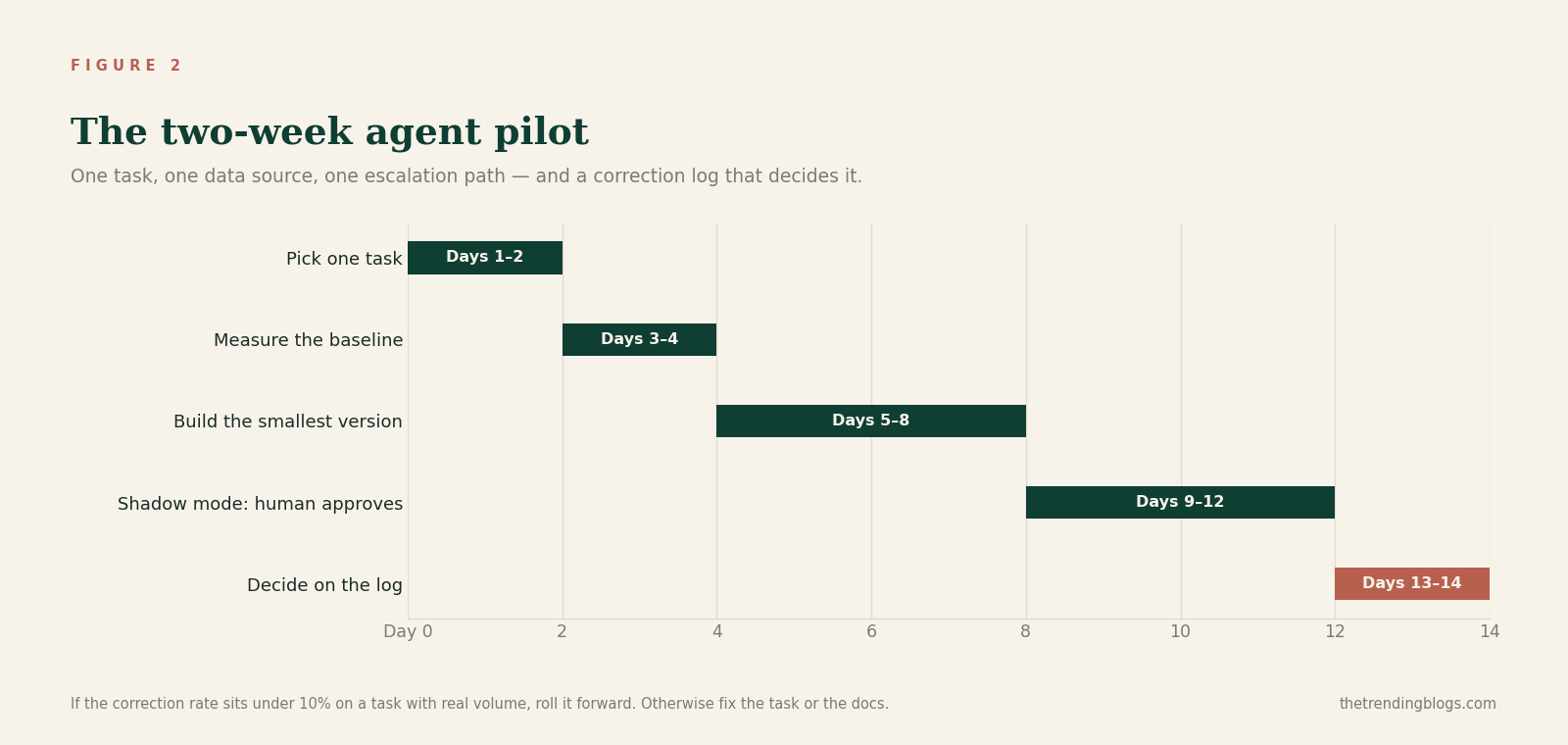
- Days 1–2: pick one task. High frequency, clear success criteria, reversible if wrong. Write down what “done correctly” means in one sentence.
- Days 3–4: measure the baseline. How long does it take now, how often is it late, what does an error cost? Without this you cannot tell success from enthusiasm.
- Days 5–8: build the smallest version. One task, one data source, one escalation path. Resist scope.
- Days 9–12: shadow mode. The agent drafts, a human approves everything and logs each correction. The correction log is the actual deliverable of the pilot.
- Days 13–14: decide. Under a 10% correction rate on a task with real volume, roll forward. Above it, either the task was wrong or the documentation was. Both are fixable; neither is a reason to buy more software.
Guardrails that are not optional
These apply to every deployment of AI agents for small business, whatever the task. Give the agent the narrowest permissions the task allows — read-only wherever reading is enough. Cap what it can spend and how many actions it can take per run. Log every action in a form a human can audit. Put a hard money threshold above which nothing happens without approval. Tell customers when they are talking to software. And keep a documented manual fallback, because the day the provider has an outage is the day you find out whether you had one.
Frequently asked questions
Do AI agents for small business replace staff?
In practice they absorb the work small teams were never getting to — after-hours enquiries, follow-ups that slipped, reconciliation left until month end. The realistic outcome is more output per person, not fewer people.
What is the minimum size of business this makes sense for?
Volume matters more than headcount. A solo operator handling forty enquiries a week has a stronger case than a fifteen-person firm handling five. If the task happens daily and takes more than ten minutes, it is a candidate.
Which tools should I start with?
Start with whatever already holds your data — most CRMs, helpdesks and accounting platforms now ship agent features that need no integration work at all. The best AI agents for small business are usually the ones already sitting inside software you are paying for. Only move to a dedicated agent platform when you have outgrown those. Our shortlist of AI tools for small business is a reasonable place to begin.
The one-line version
Automate what you can draw. Use an agent only where the work varies but the standard does not. Pilot one task for two weeks with a human approving every output, and let the correction log — not the sales demo — decide whether it scales. While you are at it, make sure those same assistants can find you: here is how AI search optimization gets your business cited by ChatGPT, and how AI is reshaping digital marketing more broadly in 2026.
