AI search optimization is the part of SEO that decides whether ChatGPT, Google’s AI Overviews and Perplexity name your business when someone asks a question you should be answering. It is not a replacement for ranking. It is a second scoreboard that runs on top of the old one, and most small business sites are currently invisible on it.
The short version: AI engines cite pages that answer a question cleanly in the first few lines, use structure a machine can parse, and are corroborated somewhere other than your own website. Fix those three things and you are ahead of almost every competitor in your category.
Why the old scoreboard stopped paying out
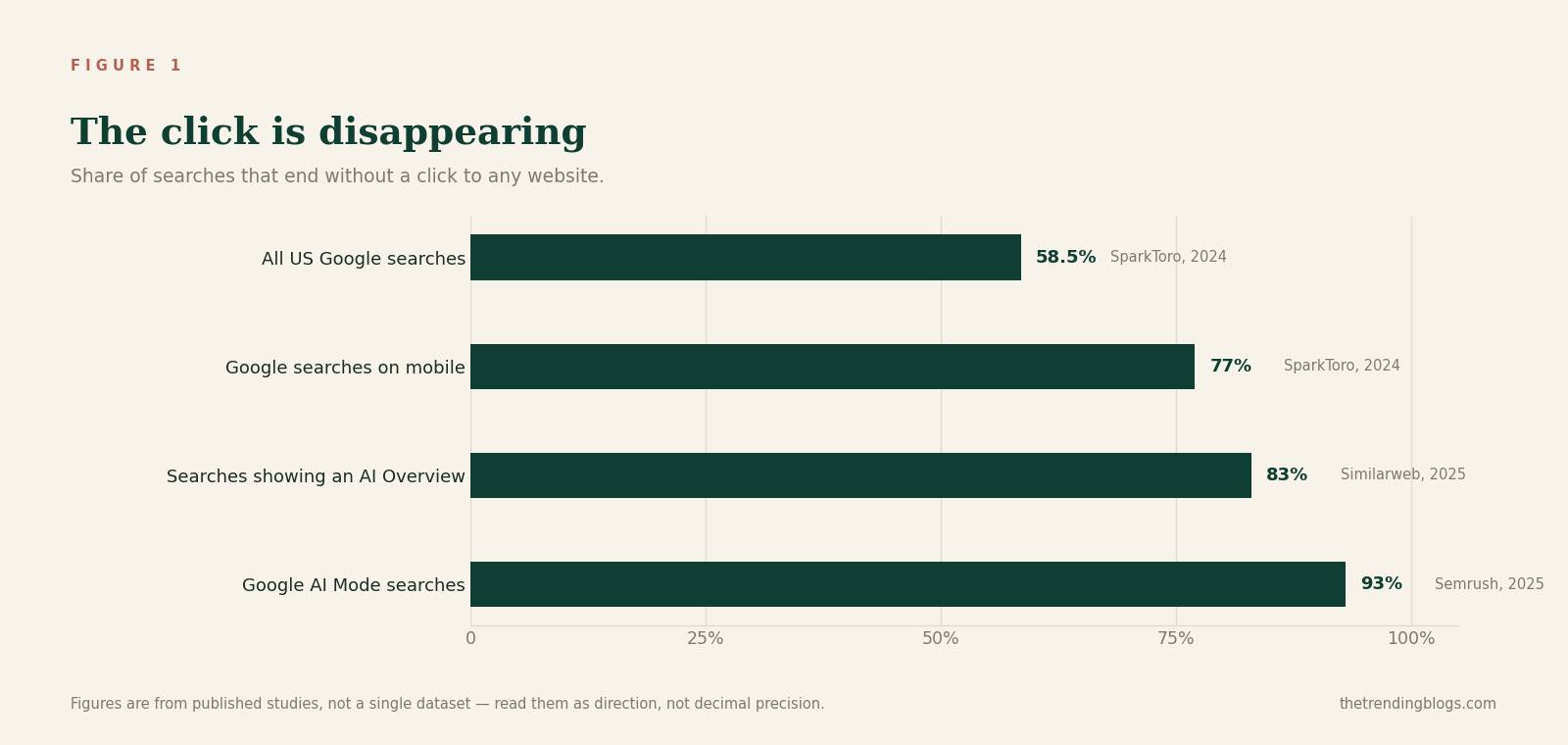
Ranking first used to mean traffic. It increasingly means being read by a summary that the user never clicks past. The numbers are blunt:
- Around 58.5% of US Google searches end without a click, rising to roughly 77% on mobile (SparkToro).
- When an AI Overview appears, Ahrefs measured a 58% drop in clicks on the number one organic result — up from 34.5% earlier in 2025.
- Semrush found roughly 93% of searches inside Google’s AI Mode end without a click at all.
- ChatGPT crossed 900 million weekly users in early 2026, and it now behaves like a search engine for a large share of them.
Read those together and the conclusion is uncomfortable but simple. A growing share of the demand for what you sell is being answered by a machine that reads a handful of pages and names two or three businesses. AI search optimization is the work of being one of them.
What AI engines are actually selecting for
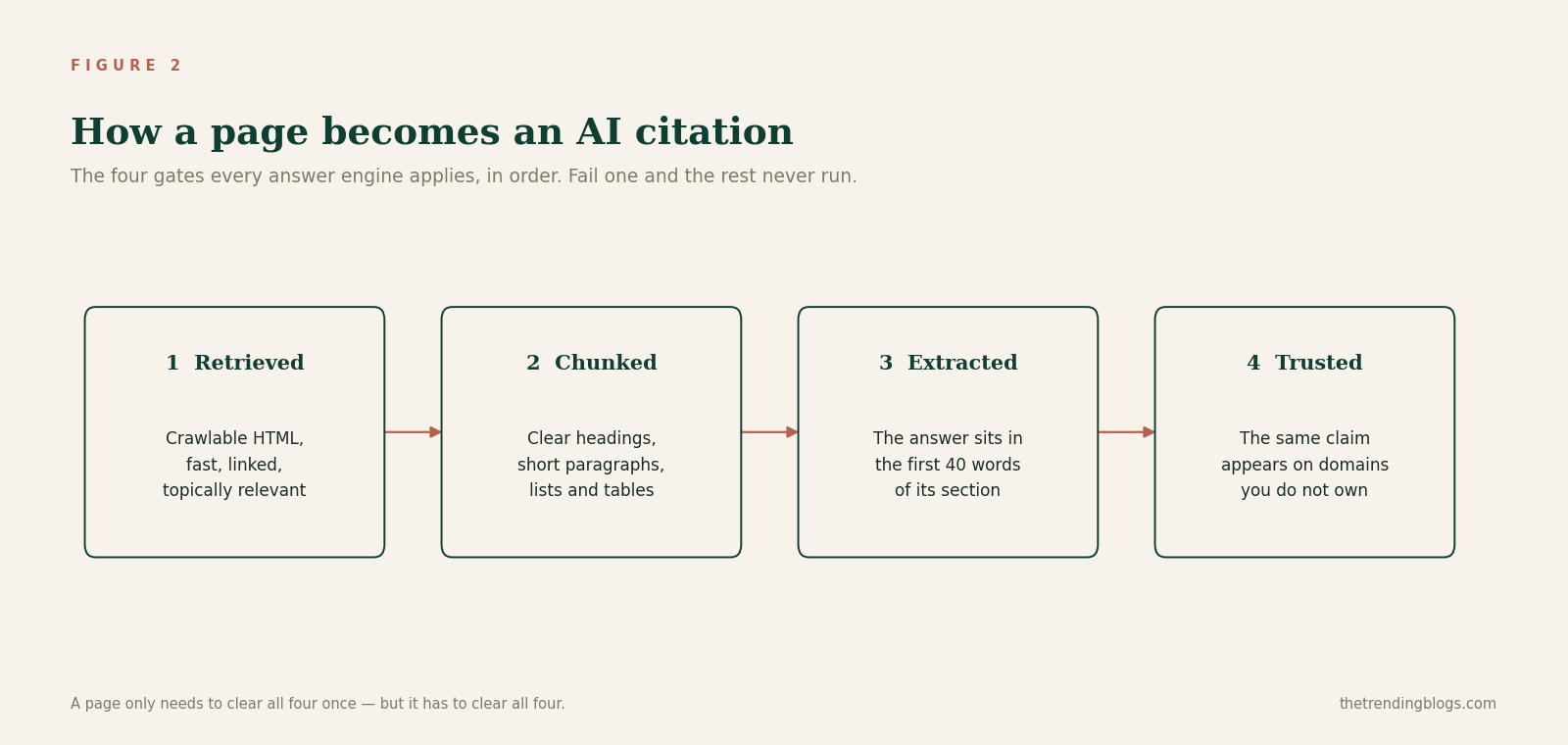
Every AI answer engine does roughly the same thing: retrieve a small set of candidate pages, extract the passages that answer the question, then synthesise. That pipeline rewards very specific properties, and none of them are the ones a 2019 SEO checklist optimised for.
1. The answer sits in the first 40 words
Extraction happens at passage level. If your answer arrives in paragraph seven after a warm-up about how the industry has changed, it will not be extracted. Put the direct answer first, in plain declarative sentences, then elaborate. Journalists call it the inverted pyramid. AI engines call it the only paragraph they read.
A useful test: delete your opening paragraph and see whether the page still answers its own headline. If it does, the opening paragraph was decoration.
2. Structure a machine can parse
Headings that state the question. Short paragraphs. Lists where the content is a list. Tables where the content is a comparison. Bold on the claim, not on the adjective. This is not a style preference — it is the difference between a passage that survives chunking and one that dissolves into surrounding text.
3. Question-shaped content, because the queries got longer
An average Google query runs about three words. An average ChatGPT prompt runs closer to twenty-three. People no longer type “plumber Delhi”; they type “who can fix a slab leak in a rented flat in South Delhi this week and roughly what does it cost”. Your pages need to contain the long, specific, awkward questions your customers actually ask — including the ones about price, timeline and what goes wrong.
4. Corroboration outside your own domain
This is the one most small businesses skip. AI engines weight agreement between sources. A claim that appears only on your homepage is a marketing claim. The same claim appearing in a directory listing, a trade publication, a review site, a podcast description and a partner’s page becomes a fact the model is comfortable repeating. Consistency matters as much as volume: one spelling of your business name, one address format, one description of what you do, everywhere.
5. Technical hygiene, which is now table stakes
Crawlable HTML rather than content assembled by JavaScript. Schema markup — Organization, LocalBusiness, Product, FAQ — so entities are declared rather than inferred. Clean URLs. And speed, because retrieval systems and users both give up on slow pages. If your site is heavy, that is the first fix, not the last: here is exactly how we took one site from 6.8s to 1.2s. If the technical side is beyond your team, this is a reasonable thing to outsource — our guide to choosing a web development agency covers what to ask for.
A 30-day AI search optimization plan
Do it in this order. Each week is genuinely a week’s work for one person, not a quarter’s project.
| Week | Do this | Done when |
|---|---|---|
| 1 | Ask ChatGPT, Gemini and Perplexity the ten questions your best customers ask before buying. Record who gets cited. | You have a baseline list of the competitors the machines currently prefer. |
| 2 | Rewrite the openings of your five highest-intent pages so the answer lands in the first 40 words. Add an FAQ block of real questions. | Every page answers its own headline above the fold. |
| 3 | Add Organization, LocalBusiness and FAQ schema. Fix name, address and description consistency across every listing you own. | Rich results test passes; no listing contradicts another. |
| 4 | Chase corroboration: two directory listings, one partner page, one guest piece, one review push. | Your core claim exists on at least four domains you do not control. |
How to measure something that does not send a referrer
AI visibility is measurable, just not in the report you are used to. Track four things:
- Citation rate. Run your ten priority questions across the major assistants once a month and count how often you are named. It is a manual survey and it is worth the hour.
- Referral traffic from AI hosts. Segment chatgpt.com, perplexity.ai, gemini.google.com and copilot.microsoft.com in analytics. The volume will look small. Look at the conversion rate before you dismiss it.
- Branded search volume. When AI answers mention you without linking, people search your name. Rising branded search with flat organic clicks is the signature of AI visibility working.
- Lead quality. Long-prompt users arrive far later in the buying process. Score these leads separately or you will misread the channel entirely.
Structured data will not get you cited on its own, but it helps engines read the page correctly. Blog schema markup in 2026 covers which types still earn rich results.
What not to do
Do not publish volume for its own sake. Twenty thin pages generated in an afternoon give the model twenty weak signals and give you a quality problem to clean up later. If you are using AI to help write, use it for research and structure and keep a human on the claims — that boundary is the theme running through how AI is changing digital marketing in 2026.
Do not abandon classic SEO. Retrieval still leans heavily on the same crawlable, linked, authoritative web. AI search optimization is an additional layer, not a migration.
Do not buy a tool before you have done the free version. The monitoring platforms are useful once you have twenty pages worth watching. Before that, a spreadsheet and an hour a month tells you the same thing. When you are ready to add tooling, this list of AI tools for small business is the honest starting point.
Frequently asked questions
Is AI search optimization different from SEO?
It overlaps by about seventy percent. The technical foundation, the crawlability and the authority signals are shared. What differs is the unit of optimisation: SEO optimises a page for a ranking position, AI search optimization optimises a passage for extraction and a brand for corroboration.
How long before it shows results?
Faster than classic SEO, because you are competing for a much smaller field. Rewrites and schema changes typically show up in assistant answers within four to eight weeks. Corroboration signals take a quarter.
Should a local business bother?
Local businesses have the most to gain. The competitive field for “best X in Y neighbourhood” is tiny, the questions are highly specific, and a consistent local profile plus LocalBusiness schema puts you in a shortlist of three rather than a page of ten.
The one-line version
Answer the question in the first forty words, structure the page so a machine can lift that answer out, and make sure someone other than you says the same thing somewhere else. Everything else in AI search optimization is a refinement of those three moves. If you want the operational side of this handled by software rather than by you, start with what AI agents can and cannot do for a small business in 2026.
