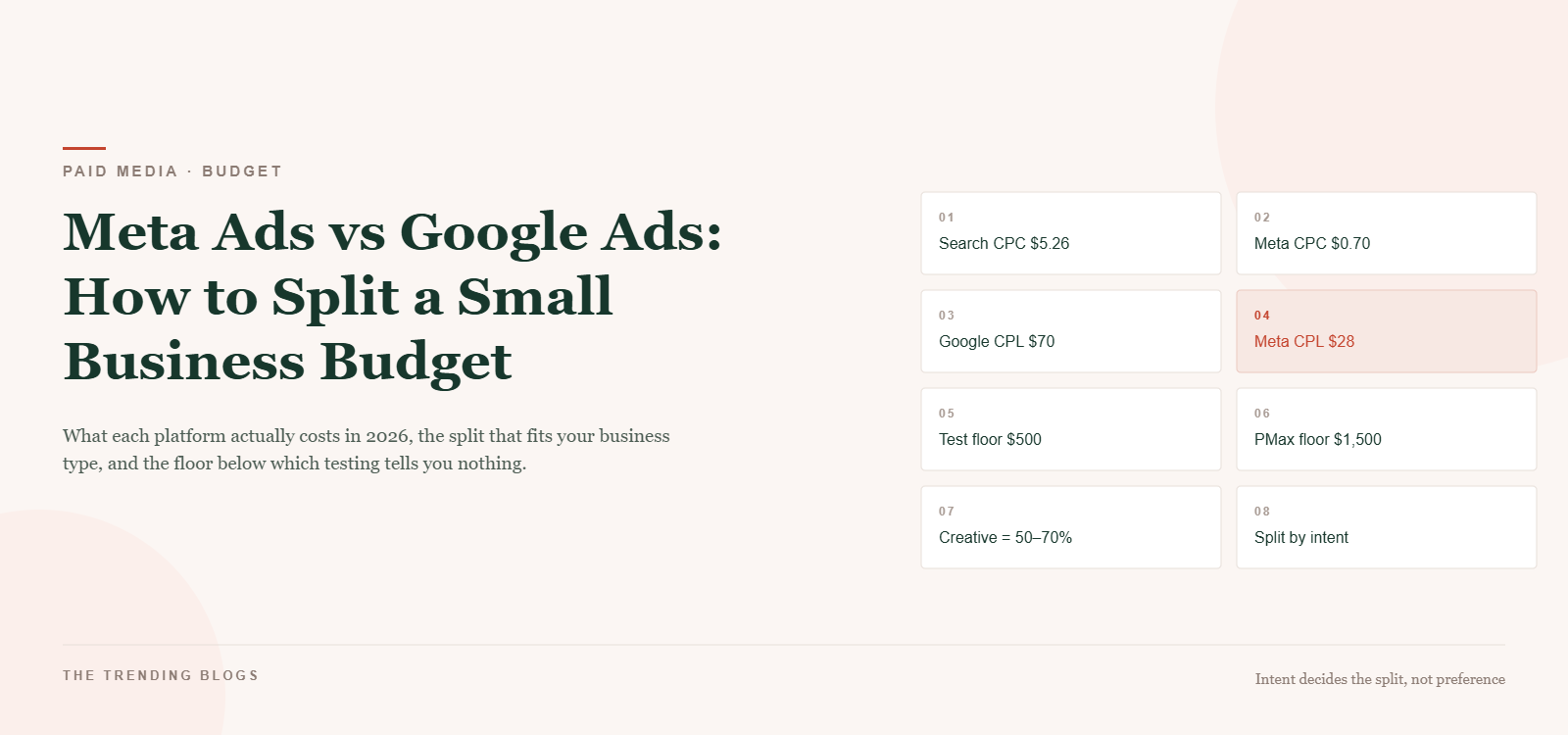
Meta Ads vs Google Ads is usually argued as a question about platforms. It is actually a question about demand. Google charges you to intercept demand that already exists and has been typed into a box. Meta charges you to create demand in people who were not looking for you. Those are different jobs, they cost different amounts, and the split that works for a D2C candle brand will quietly bankrupt a commercial roofing company.
So the honest answer to how to split the budget starts with what kind of demand your business runs on — and then with a hard look at whether your budget is big enough to learn anything on either platform at all.
What each platform actually costs in 2026
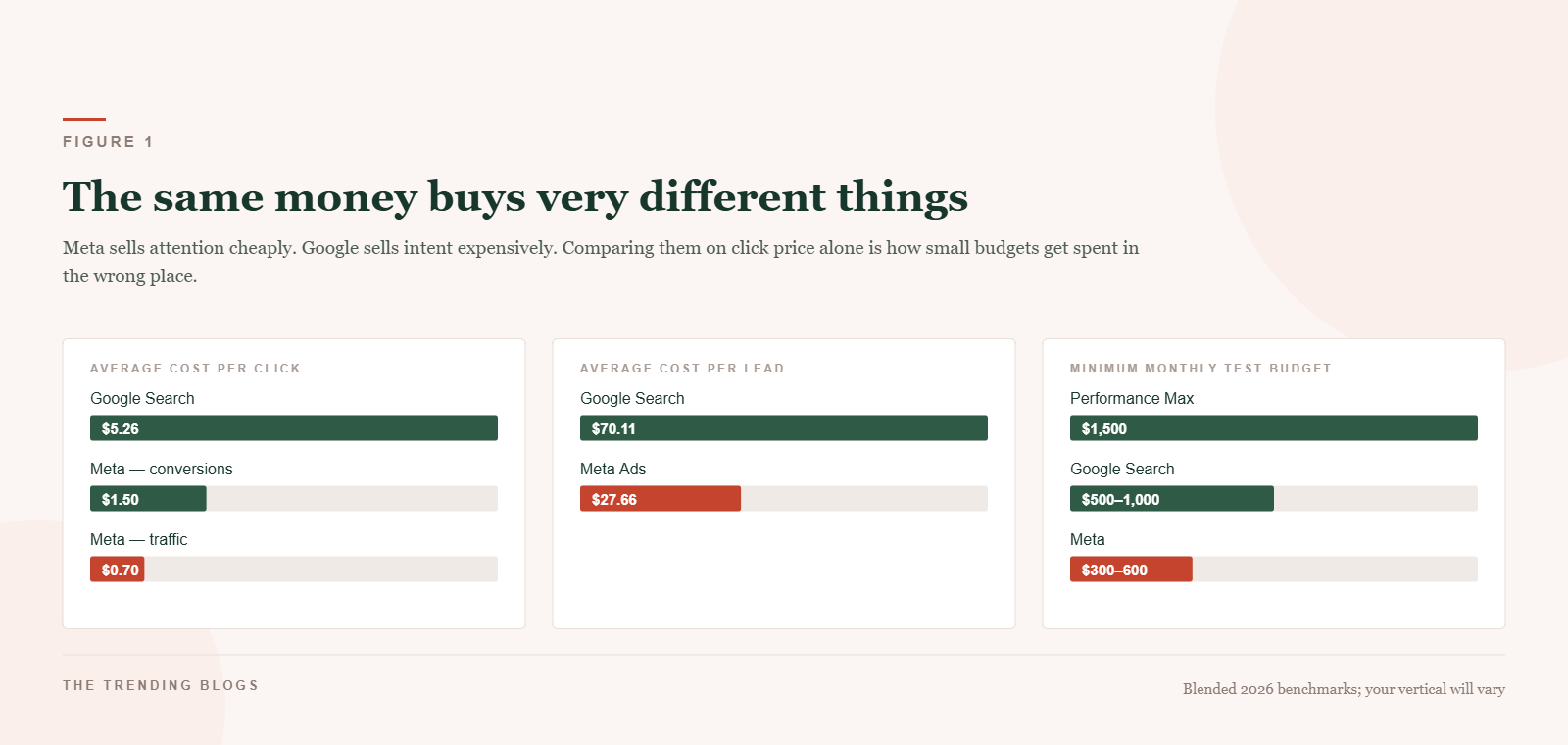
Blended benchmarks are blunt instruments, but they set the scale. Google Search averages around $5.26 per click, with industry ranges running from roughly $1.60 to $8.58. Meta traffic clicks average about $0.70, and Meta conversion-objective clicks land nearer $1.00 to $2.00. On impressions the order flips: Google Display sits near $3.12 CPM while Meta feed placements run $10 to $14, with Stories and Reels a little cheaper at $8 to $12.
Cost per lead is where the argument usually gets settled prematurely. Google Search averages about $70 per lead; Meta averages closer to $28. Roughly sixty percent cheaper, which sounds decisive until you ask what the lead is. (Figures are in US dollars — convert to your market, but the ratios travel better than the absolute numbers do.)
Why the cheap channel is not the cheap channel
A Meta lead is often someone who saw a good piece of creative, felt something, and filled in a form in nine seconds. A Google Search lead is someone who typed emergency plumber Andheri at midnight. Both are leads in your CRM. Only one of them was already in the market.
This is why cost per lead is the wrong scoreboard for small budgets. The metric that matters is cost per qualified opportunity — a lead your team would actually pick up the phone for. Track that for six weeks and the gap between platforms usually narrows, sometimes reverses, and occasionally justifies a Meta cost per lead three times higher than you expected because volume made the sales process viable.
It also means your split cannot be decided from a benchmark table. It has to be decided after the fact, from your own numbers, which is the part most businesses skip.
The floor below which testing tells you nothing
There is a minimum spend at which each platform can produce a signal rather than noise, and running below it is not frugal — it is paying for an inconclusive experiment.
- Meta: $300 to $600 a month to test properly, scaled up 20 to 30% every three or four days once something works.
- Google Search: $500 to $1,000 a month, because you are buying clicks at five dollars and need enough of them to see a conversion pattern.
- Performance Max: $1,500 a month minimum, and a genuine four to six week learning phase before the numbers mean anything. PMax on a small budget is the most common way to waste a quarter.
If your total budget is under about $500 a month, do not split it. Pick the platform that matches your demand type, run it properly, and revisit in a quarter. Two half-funded channels produce two sets of unreadable data.
The split, by business type
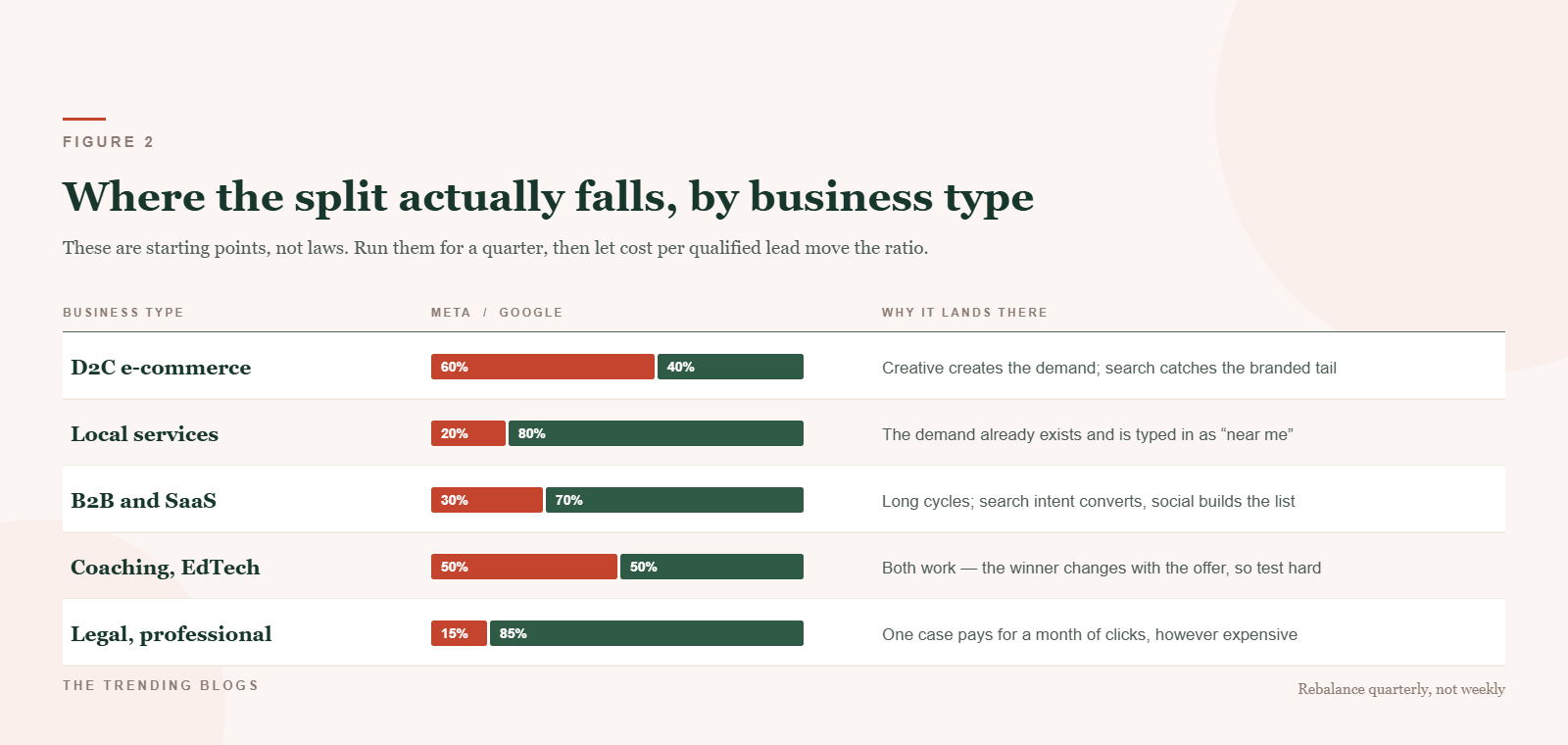
| Business type | Meta / Google | Why |
|---|---|---|
| D2C e-commerce | 60 / 40 | Creative creates the demand; Search catches the branded searches that follow. Typical winners see 4x and up on Meta. |
| Local services | 20 / 80 | Demand already exists and gets typed in. Google ROAS in this category commonly runs 5x to 10x. |
| B2B and SaaS | 30 / 70 | Long consideration cycles. Search converts the in-market few; Meta builds the list everyone else comes from. |
| Coaching and EdTech | 50 / 50 | Genuinely split. The winner changes with the offer, so both channels need real budget to compare. |
| Legal and professional | 15 / 85 | One matter can pay for a month of clicks, which justifies $8 CPCs that would be insane elsewhere. |
Two rules make these numbers useful rather than decorative. First, always keep a small always-on branded search campaign regardless of the split — it is the cheapest inventory you will ever buy and it stops competitors buying your name. Second, rebalance quarterly, not weekly. Weekly reallocations reset learning phases faster than either platform can recover from.
What genuinely changed on both platforms this year
Meta pushed further into broad, signal-led delivery. Manual audience carving now underperforms broad targeting in most small accounts, and creative is estimated to drive 50 to 70% of ad performance. The practical constraint is fatigue: expect a winning creative to decay within 7 to 14 days, which makes production cadence a media variable, not a design preference.
Google leaned harder into automation too. AI-driven Search expansion has been reported to deliver around 14% more conversions at similar cost per acquisition, and Performance Max adoption reached roughly 71% of advertisers. The catch is the same as ever: automation optimises towards whatever conversion you feed it. Feed it form fills and it will find you form fillers.
Both directions point the same way — the leverage moved from targeting settings to creative volume and conversion quality. That is a shift in what your team spends its hours on, and it is part of the broader pattern we described in how AI is changing digital marketing in 2026.
Where paid stops being the answer
Paid media is a rented audience. It is worth renting when the economics work, but a small business that only rents is fragile. Two cheaper channels sit next to it and both got more valuable as AI compressed organic results.
If you sell locally, the profile is the asset: Google Business Profile optimization for AI search now decides whether you appear in a three-result answer, and it costs nothing but attention. If you sell nationally, being cited in AI answers matters for the same reason — here is how to get your business cited by ChatGPT and AI Overviews. And organic social still compounds when it is systematised rather than improvised; we covered a workable version in how small businesses can automate Instagram marketing.
Once prospecting is running, a small retargeting layer usually earns more per dollar than extra reach. Retargeting on a small budget covers the three audiences and frequency caps that keep it honest.
The mistakes that burn small budgets fastest
- Splitting a budget that is too small to split. Covered above, and still the most common error by a wide margin.
- Judging week one. Both platforms need a learning period. Killing a campaign on day four is buying an experiment and throwing away the result.
- Optimising to the wrong event. If a form fill and a qualified enquiry are not the same thing for you, do not let the algorithm treat them as such.
- One creative, endless budget. On Meta this is now the binding constraint. Three to five fresh concepts a month beats any targeting tweak.
- No branded search campaign. Cheap, high-intent, and frequently the highest ROAS line in the account.
- Comparing platforms on last-click. Meta creates demand that Google harvests. Last-click attribution will always credit the harvester and always underfund the creator.
Doing this without hiring a team
The operational load is the real barrier for most small businesses — creative production, weekly checks, reporting. That is a good use of automation and a bad use of blind trust. Practical starting points are in AI automation ideas that save small businesses hours every week and the tooling shortlist in 10 AI tools every small business should use in 2026.
One caution, though. Budget reallocation and bid changes are exactly the sort of judgement-heavy, hard-to-reverse decision where autonomous tools tend to embarrass their owners — the boundary is worth reading properly in what AI agents for small business actually do well. Automate the reporting and the creative pipeline; keep the money decisions on a human.
Meta Ads vs Google Ads: the short version
Pick your split from your demand type, not from a benchmark you read. Fund one platform properly rather than two badly. Judge both on cost per qualified opportunity rather than cost per lead. Keep branded search on permanently, rebalance quarterly, and treat creative volume as a media cost. Do that and the Meta Ads vs Google Ads question stops being interesting, which is exactly the point.
